This Content is written by Human, not AI robot. Learn More
If you have a Samsung refrigerator that comes with an ice or water dispenser, you’ll find a tiny device that is doing a lot more than people think. The Samsung fridge water filter sits between the glass of water you drink and the water that is inside your house’s water supply line, including its chlorine smell, sediment, and, in some cases, lead. When you’re done, you don’t even think about the issue. If you do it wrong, you’re faced with leaks or a stuttering indicator light or even water that isn’t as tasty as it was in the past.
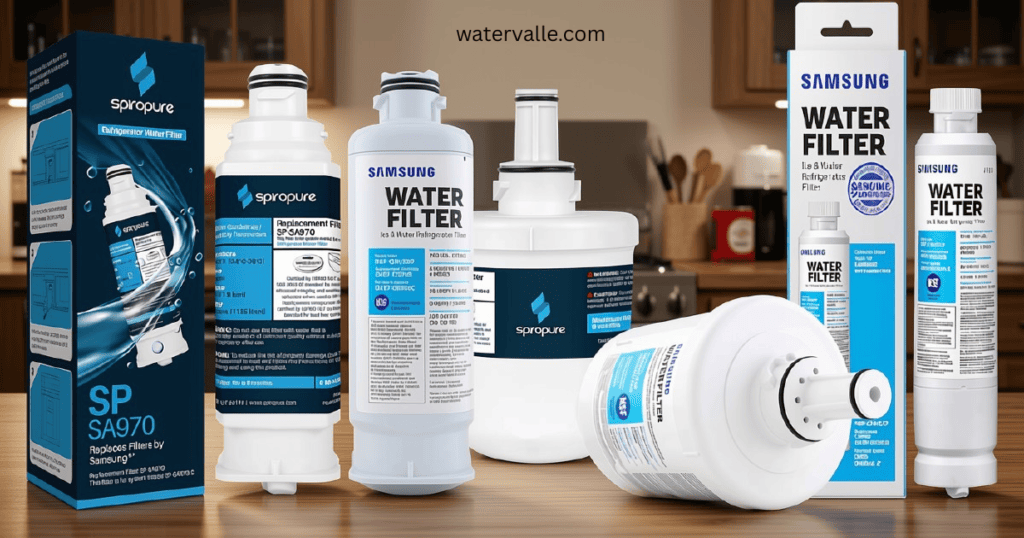
This article explains all the important aspects of which Samsung fridge water filter is best suited to the model you have, how long it will last, the best way to change it and restart it, and whether the cheaper option from a third party is worthwhile.
What a Samsung Fridge Water Filter Actually Does?
The principle behind a Samsung fridge water filter is that it is composed of an activated carbon block. Water moves through the carbon before it gets to the ice maker or dispenser, and as it moves through the carbon, it is able to absorb chlorine, flavor, and smell. It also collects dirt and, based on the particular model’s certification, reduces the presence of contaminants such as lead.
This last point is more important than most of the buyers are aware. Not every Samsung fridge water filter is scored in the same way. Samsung’s cartridges are usually accredited to two distinct standards:
- NSF/ANSI 42 covers aesthetic effects like chlorine taste and reduction of odor.
- NSF/ANSI 53 includes health impacts: reducing the presence of pollutants like lead and other organic substances.
A filter certified to NSF/ANSI 42 can make your water more delicious. The one that is certified to NSF/ANSI also performs real health-related filtration. These numbers will usually be found on the package. It’s a good idea to check prior to purchasing because it’s the most important aspect that distinguishes a verified filter from one simply… It’s a shapeless item.
Which Filter Fits Your Refrigerator
Samsung does not use a single universal cartridge for its entire range. Based on the age and design of the door on your fridge, it’s likely that you’re looking at one of the following:
| Filter Model | Common Use Case | Housing Style |
| DA29-00020B | Most French-door and side-by-side models, 2011–present | External pull-out |
| DA29-00019A | Earlier side-by-side models | External twist, narrower housing |
| DA29-00003G / HAFCU1 | Select older models | External, different shape |
| DA97-08006A | Newer French-door and 4-door Flex models | Internal, behind the front grille |
Since these housings can’t be interchanged, the purchase of a refrigerator by model alone is what most people make the mistake of. If you’re a homeowner who has a 2018 French-door refrigerator, for example, you may think the “older-sounding” DA29-00019A is correct, but the correct match is DA29-00020B- the mismatch only comes when the container has been open.
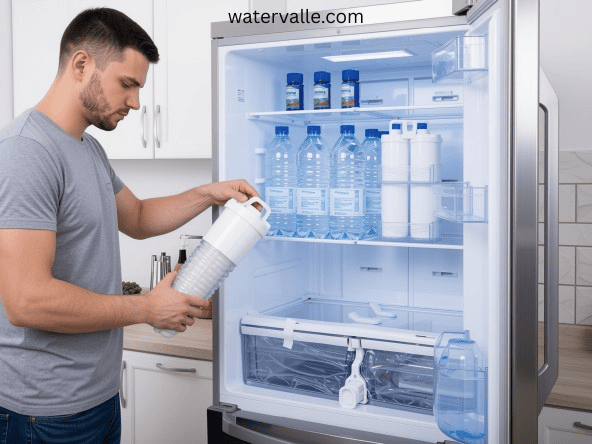
The most secure way to ensure the compatibility of your device is to:
- Look at the old cartridge. The part number appears directly on the cartridge.
- Search for your refrigerator’s entire model number located in the refrigerator’s compartment. You can also look it up on Samsung’s parts page.
- Release it by pressing the button, and then pull it out straight away, or turn it counterclockwise around 12 turns, based on the model you have. Then remove any protective caps from the cartridge and check for an alignment hole.
How Often You Actually Need to Replace It
Samsung’s guidelines are to flush the system every 6 months, which is around 300 gallons in the event of a first. However, that’s an average, and it’s not a standard that applies to every household.
- The average household with municipal water: 6 months
- Big household or high water/ice use: up to 4-5 months.
- Water from wells or high-sediment supplies: 3-4 months
An overdue filter doesn’t declare itself in a loud manner. It’s not shut down immediately, but it slowly decreases its capacity to adsorb contaminants while letting water flow through. This is the reason waiting for liquid to “taste off” isn’t a method of ensuring that the Samsung fridge water filter is working.
Fridge Filter vs. Bottled Water
It’s worthwhile to put the price of the Samsung refrigerator water filter against alternatives that many homeowners choose, such as buying bottles of water. If a family consumes just a few cases of water bottles a week, they will likely spend more than what an actual filter would cost. And this is before taking into account the waste of plastic.
This doesn’t mean that bottled water isn’t the best choice; however, if you’re faced with an issue of a contaminant that has been documented that a carbon filter can’t get rid of, drinking bottled water or a water filtration system may need to be considered. However, for a typical family whose primary concern is flavor, chlorine odor, and daily comfort, a clean and well-maintained fridge filter will provide the same benefits at only a small fraction of the expense.
How This Compares to Other Refrigerator Brands
If you’ve had a previous refrigerator model, the basic concept is likely to be familiar; however, the details may differ. LG, Whirlpool, and GE refrigerators are all equipped with exclusive filter cartridges as well, but there is no way to interchange them with Samsung’s part numbers or with one another, in fact.
What tends to differ most between brands isn’t the filtration technology itself — most competing filters are also activated-carbon-based and NSF/ANSI certified — but the replacement interval and housing design. Certain GE models, for example, employ a similar 6-month period, but specific Whirlpool cartridges have a capacity of around 200 gallons instead of more than 300. When you’re looking for a new fridge, the cost of filtering and availability should be considered along with the price of the appliance, as you’ll need to purchase the cartridge at least two each year, throughout the time you own the refrigerator.
Replacing and Resetting the Filter
Most models it takes less than an hour and do not require equipment.
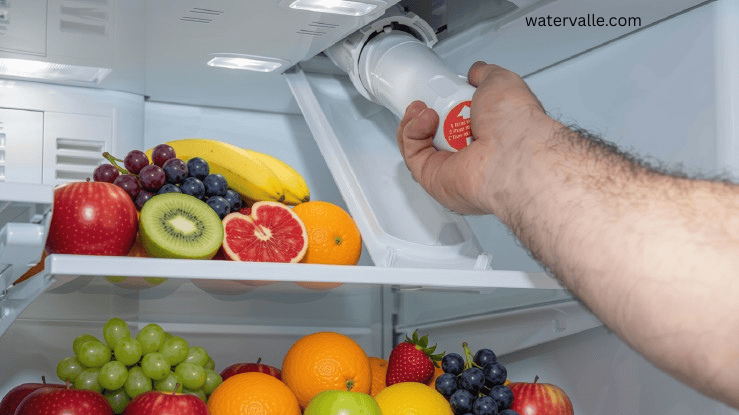
- Find the Samsung fridge water filter; it could be in the upper chamber (external model) or under the base grille (internal models, such as DA9708006A).
- It can be released with a push, after which you can pull it out immediately, or rotate it in the counterclockwise direction for 12 degrees, depending on the model you’ve got. Remove any caps that protect the cartridge, then look for an alignment hole. Install and secure the new filter in place.
- Pour 2-3 gallons of water into the dispenser prior to drinking to remove the air and carbon particles.
- Set the indicator.
For a reset of the LED in most touch-panel models, hold and press the Samsung fridge Water Filter or Filter Reset icon for around 3 seconds or until it is clear. For older models with buttons, you must hold the button to reset for the same time. If the light doesn’t come on, unplugging your fridge for about a minute before reconnecting it causes the system to reboot properly. More frequently than not, the light refusing to turn off means that the unit hasn’t been properly installed, rather than an issue with the electronics.
A crucial point that is often overlooked: make sure the O-ring was taken out along with the previous filter. If it remains inside the housing, then the Samsung Fridge water filter that was replaced could be leaking unless you remove and replace it.
Genuine Vs. Third-Party Filters
The most common buying doubts arise, and this is an appropriate thing to be aware of.
The genuine Samsung cartridges ensure a perfect fit of the housing and flow calibration. They also have certifications specific to the component. They usually cost between $45 and $50.
Compatible filters from third parties are priced between $20 and $35, occasionally less; however, the quality of these Samsung fridge water filters varies widely. Many use inferior-grade carbon media, which Samsung fridge water filters less efficiently during the same period of time, even if the housing is a perfect fit.
The primary determinant shouldn’t be just price; it’s the certificate:
- If your water quality report from the municipality indicates specific contaminants, prioritize Samsung fridge water filters certified by NSF/ANSI53 either genuine or third-party.
- If the main issue you have is the taste of your water and it conforms to EPA standards, then an NSF/ANSI 42 certified compatible filter can be an acceptable way to save the cost of your water.
- Avoid anything that has no NSF/ANSI code, no matter how much it costs.
What It Actually Costs Over Time
| Filter Type | Typical Price | Certification | Rough Annual Cost (6-month cycle) |
| Genuine Samsung DA29-00020B | $45–$55 | NSF/ANSI 42, 53 | $90–$110 |
| Genuine Samsung DA97-08006A | $40–$50 | NSF/ANSI 42, 53 | $80–$100 |
| Certified third-party | $20–$35 | Varies — check packaging | $40–$70 |
| Uncertified generic | Under $20 | Often none | Not recommended |
(Pricing represents typical retail ranges seen in the past few years. The actual price varies for each retail store and region.)
When Things Go Wrong ?
The flow of water is slow after replacing: Usually, trapped air is flushed through a couple of Gallons of water, and it usually clears.
Moving around in the filter housing: Nearly always a missing, damaged, or wrongly aligned O-ring or cartridge that’s not fully secured.
The light for the filter will not change: Reseat the cartridge to its fullest and then try the reset process again. If it doesn’t work, then a short power cycle will usually resolve it.
Ice maker stops when a Samsung fridge water filter is changed: Air in the line may cause the ice maker to cease production briefly. Running the dispenser for several minutes before letting the process complete will usually fix the issue.
The water’s taste is slightly different immediately following the installation: New carbon cartridges are able to emit fine carbon dust during the initial use. This is precisely why flushing the first time plays a role.
A Few Mistakes Worth Avoiding
- By refrigerator model rather than confirming the exact filter’s part number
- The taste alone will likely inform you that it’s time to change the item.
- Inducing a twist-style cartridge to turn in the wrong direction could cause the housing to crack
- Doing away with the post-installation flush
- A filter without NSF/ANSI accreditation simply because it’s the most affordable choice
An Alternative Worth Knowing About
If your home is afflicted with greater water quality issues such as heavy sediment and hard water or a specific contaminant that the municipal reports flag, a refrigerator filter isn’t enough to solve all issues. Filtration systems that cover the whole kitchen or are underneath the sink can offer a wide range of issues and work alongside your Samsung fridge water filter without having to change the filter. Under-sink or whole-house filtration systems can handle a wider range of problems and can work with the refrigerator’s filter, not a replacement. An Alternative Worth Knowing About. Under-sink or whole-house filtration systems can handle a wider range of problems and are able to work with the refrigerator’s filter, not a replacement.
Whole-house systems are set up near the point that the water gets into your house, which means they deal with everything, including laundry, showers, as well as every faucet, including the fridge dispenser. These are the best option for the effects of hard water on appliances and plumbing generally, not only the taste of water.
Reverse osmosis systems that are under-sink are more advanced than carbon filtration and remove a greater range of dissolved substances and contaminants that a refrigerator’s cartridge is made to manage. They are a good option in the event that a water test is able to identify something that a typical carbon filter can’t handle.
Neither of these options replaces the necessity of the Samsung refrigerator’s internal filter; the refrigerator’s own internal water line is still required to have its own water filter, regardless of what’s going on upstream. Consider it layered protection, not an either/or option: a complete house or under-sink solution covers the entire water supply, and the refrigerator filter takes care of the final stage right prior to it reaching the glass or tray.
This information is gathered from different surveys, medical tests, and tech giants like Google, TechRadar, and more. Our top priority is to provide you with valuable information.
For More Details About Different Water Appliances, Click Here
FAQ
- Do all Samsung refrigerators come with the same water filter?
No. Samsung has employed a broad selection of different types of filters on the various doors and refrigerators. So the best cartridge will depend on the model of your refrigerator, not just the model.
2. Do I have to run my Samsung refrigerator with no water purifier?
Yes, using a bypass plug; however, the dispenser and the Ice maker would then create pure tap water that is not filtered and has none of the flavor or reduction advantages.
3. How can I tell what time of the year my Samsung fridge water filter requires replacement?
The control panel generally displays the “Replace Filter” indicator based on an approximately 6-month or 300-gallon period, but slow flow or changes in taste could also indicate that it’s past due.
4. Do you need to be cautious when you utilize a Samsung-compatible filter from a third party?
Many are perfectly protected, provided they are able to show NSF/ANSI 42 and 53 certification. Beware of generic cartridges that are not certified, regardless of the price.
5. What’s the issue? What’s wrong with my Samsung fridge water filter that’s leaking?
Most often, the reason is that it’s an O-ring that’s not aligned properly, or there’s a water filtration system not securely attached in the enclosure.
6. How long will a Samsung fridge water filter really run for?
About 6 months or 300 gallons with average use. This could be shorter in the case of the water from a well, a high level of concentration of sediment, or an entire household that is using this dispenser often.
7. Where can I purchase an authentic Samsung fridge water filter?
Samsung’s official parts website, the major appliance stores, and huge online marketplaces have genuine cartridges available; you need to confirm the exact part number for your fridge before placing your order.
8. Why does my Samsung fridge water filter’s reset light come on after I switched the filter?
It usually means the new filter hasn’t been fully installed. Reinstall it, and re-run the reset procedure. In case that doesn’t work, disconnecting the refrigerator for a few minutes usually causes the reset process to begin.
Conclusion
The Samsung fridge’s water filter is among the small items of maintenance that are simple to overlook until there’s a problem -the leak, a blinking indicator light that is stuck, or water that tastes different. The process isn’t too complicated when you’ve identified your specific filter’s type, follow the 6-month replacement schedule, and know what the NSF/ANSI certification actually tells you.
Check the part number on your cartridge and make sure you know if it’s in the process of changing it. Make a schedule reminder, instead of relying on the indicator light by itself, and when it’s time to purchase a new cartridge, let certification, not only price, decide the decision.